
Description
Overview
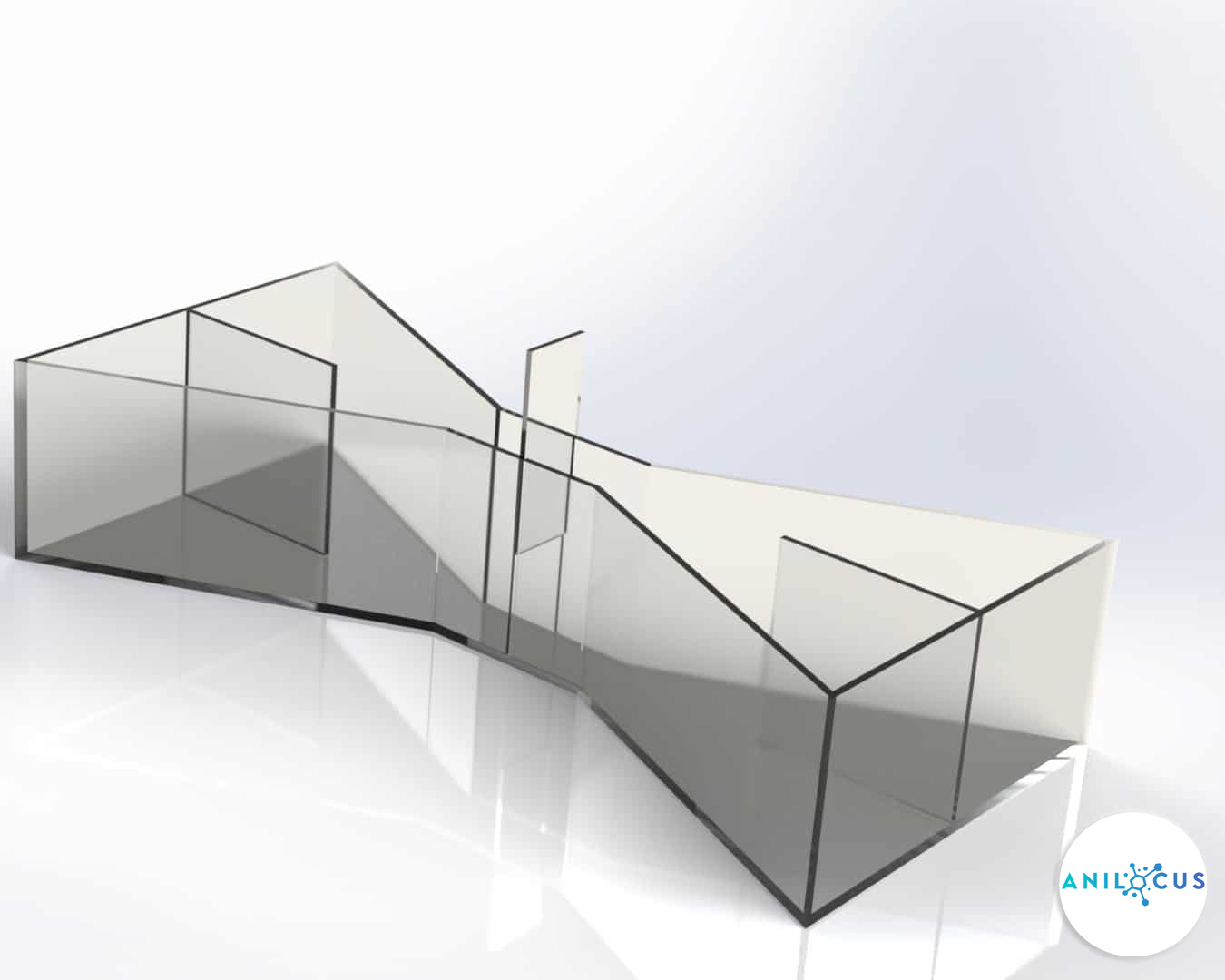
The Bowtie Maze is a sophisticated behavioral testing apparatus designed for assessing recognition memory in rodents through continuous object recognition paradigms. This innovative bowtie-shaped system combines the strengths of delayed nonmatching-to-sample tasks with spontaneous object exploration, enabling researchers to conduct multiple recognition trials within a single testing session. The Bowtie Maze addresses critical limitations in traditional object recognition testing by reducing variance, minimizing handling stress, and providing a controlled environment for evaluating hippocampal, perirhinal cortex, and fornix function in both normal and pathophysiological conditions.
The apparatus permits adequate training by offering multiple trials per session, with recognition measures firmly rooted in the rodent’s innate preferential exploration of novelty. This innovative maze design allows the rodent to efficiently complete object recognition trials multiple times in one session while reducing variance from spontaneous recognition tasks . The Bowtie Maze combines the design principles of both delayed non-matching to sample and spontaneous object recognition tasks, allowing multiple trials to take place with minimal handling compared to previous studies with other apparatuses .
Key Features and Benefits
- Multiple Trial Efficiency – Enables up to 20 recognition trials in a single session, dramatically increasing data collection while reducing animal handling
- Dual Species Design – Optimized configurations available for both mice and rats with species-appropriate dimensions and object placement
- Guillotine Door Control – Central sliding door mechanism allows precise control of animal movement and trial progression
- Integrated Food Wells – Recessed reward wells in each triangular end encourage object exploration and maintain motivation throughout testing
- Reduced Variance Design – Multiple trials per session significantly reduce the inherent variance of spontaneous object recognition tasks
- Customizable Configurations – Available with transparent or opaque walls in multiple colors for optimal experimental conditions
Applications in Behavioral Neuroscience
Recognition Memory Assessment
The Bowtie Maze assesses recognition memory that can be explored in normal conditions with an assessment of animal strains or with a pathophysiological assessment of hippocampal, fornix, or perirhinal cortex function. Researchers can evaluate both short-term and long-term object recognition capabilities across multiple retention intervals.
Continuous Object Recognition Testing
Sessions involve multiple trials during which rodents are first introduced to a single sample object, and are then tasked to progressively discriminate between object pairs that are simultaneously encountered as they go back and forth the maze, with each novel object becoming the familiar object in the following pair .
Sensory Modality Research
The easy pattern of behavior (going back and forth the same apparatus) enables the testing of sensory modalities aside from vision, providing a look into the interplay between sensory systems , making it valuable for multimodal recognition studies.
Neurological Disease Models
Impaired function of hippocampal, fornix, or perirhinal cortex structures allows for assessment of recognition memory deficits in models of Alzheimer’s disease, dementia, and other cognitive disorders.
Pharmaceutical Development
Studies of retention intervals and the impact of delay on recognition are more easily observed within a single session without necessitating the removal of the rodent from the apparatus , making it ideal for drug efficacy testing and cognitive enhancement research.
Scientific Validation
The Bowtie Maze was described by Albasser et al, 2010 for rodents as a novel object recognition assay that assesses recognition memory, derived from a combination of spontaneous object exploration and the nonhuman primate delayed nonmatching-to-sample tests established in 1975. The Bowtie Maze presents a modern behavioral protocol that conveniently combines the strongest features of standard object recognition measures, particularly delayed nonmatching to sample and spontaneous exploration . Published studies demonstrate its effectiveness in reducing methodological limitations found in traditional object recognition paradigms while maintaining robust scientific validity across multiple research applications.
Specifications
| Specification | Details |
|---|---|
| Overall Dimensions | 47″ (120 cm) length × 20″ (50 cm) width × 20″ (50 cm) height |
| Corridor Width | 5″ (12 cm) with central guillotine door |
| Triangular End Chambers | Two symmetrical chambers with integrated food wells |
| Material Construction | High-grade acrylic with smooth, easy-clean surfaces |
| Wall Options | Clear (transparent), opaque (black, white, grey, cream) |
| Food Well Design | Recessed reward wells covered by test objects |
| Weight | Approximately 45 lbs (20 kg) assembled |
| Species Compatibility | Mice and rats (scalable design options available) |
| Testing Conditions | Controlled lighting, minimal external cues required |
Equipment Integration
The Bowtie Maze integrates seamlessly with behavioral analysis software and video tracking systems for automated data collection and analysis. The apparatus features standardized mounting points for overhead camera systems and supports comprehensive behavioral measurement including exploration time, object preference ratios, and recognition indices. The modular design allows for easy customization and integration with environmental control systems, making it compatible with existing laboratory infrastructure and experimental protocols.
Automated Analysis Integration Features:
- Overhead camera mounting compatibility for complete behavioral tracking
- Integration with major behavioral analysis software packages
- Automated trial progression monitoring with door control systems
- Real-time data collection for exploration times and object preferences
- Compatible with environmental control systems for lighting and temperature
Documentation
Getting Started
- Bowtie Maze Setup Guide – Complete assembly instructions and initial configuration procedures
- Animal Habituation Protocol – Pre-training procedures and food restriction guidelines
- Basic Testing Protocol – Standard 20-trial recognition memory assessment
Object Recognition Protocols
- Continuous Recognition Testing – Multi-trial object recognition with progressive familiarity
- Retention Interval Studies – Protocols for short-term and long-term memory assessment
Data Analysis and Interpretation
- Recognition Performance Analysis – Calculating discrimination ratios and recognition indices
- Statistical Analysis Guide – Appropriate statistical tests and interpretation guidelines
- Analysis Templates – Standardized data collection and reporting formats
Advanced Applications
- Multimodal Recognition Testing – Protocols for visual, tactile, and olfactory object recognition
- Drug Testing Applications – Guidelines for cognitive enhancement and impairment studies
- Neurological Disease Applications – Protocols for Alzheimer’s, dementia, and cognitive disorder research
Troubleshooting & Optimization
- Performance Optimization Guide – Solutions for common testing issues and protocol refinements
Ordering Information
Standard Configuration
- Bowtie-shaped maze apparatus with central corridor
- Guillotine door mechanism with manual control
- Integrated food wells in both triangular chambers
- Opaque wall dividers between food wells
- Assembly hardware and detailed instructions
Optional Upgrades
- Automated door control system with remote operation
- Multiple wall color options (black, white, grey, cream)
- Enhanced food delivery system with precise portion control
- Integrated lighting system for standardized illumination
- Custom object holders and standardized test objects
Shipping Information
- Shipping Dimensions: 52″ × 25″ × 25″
- Shipping Weight: 55 lbs with protective packaging
- Professional packaging with foam inserts and assembly guide
- Assembly required (approximately 3 hours with standard tools)
- Shipping Costs (based on UPS rates): Contact for destination-specific quote
Purchase Note
The Bowtie Maze ships as a complete system including the main apparatus, guillotine door mechanism, food wells, and all assembly hardware. Assembly requires approximately 3 hours using standard tools and included instructions. The apparatus requires a minimum 6′ × 3′ testing area with stable surface mounting. Test objects are not included and should be selected based on specific experimental requirements. Professional installation and training services are available upon request.
Frequently Asked Questions (FAQ)
How many trials can be conducted in a single testing session?
Each session of standard object recognition in the bowtie maze consists of 20 trials, during which the rodent freely explores two objects at a time, one novel and one familiar . This multiple-trial approach significantly increases data collection efficiency compared to traditional single-trial paradigms.
What is the advantage of the Bowtie Maze over traditional object recognition tests?
The Bowtie Maze allows the use of fewer animals for experimentation as multiple trials can take place with minimal handling compared to previous studies with other apparatuses . Multiple trials help in reducing variance from spontaneous recognition tasks .
How does the food reward system work in the Bowtie Maze?
In contrast to the standard object recognition task, reinforcement does not directly guide recognition performance in the bowtie maze, but only works to encourage exploration. Both the novel and the familiar object are baited , ensuring motivation without biasing object preference.
Can the Bowtie Maze be used for different sensory modalities?
The easy pattern of behavior (going back and forth the same apparatus) enables the testing of sensory modalities aside from vision, providing a look into the interplay between sensory systems , making it suitable for tactile, olfactory, and multimodal recognition studies.
What brain regions does the Bowtie Maze assess?
The Bowtie Maze assesses recognition memory in normal conditions and provides pathophysiological assessment of hippocampal, fornix, or perirhinal cortex function. Impaired function of either structure allows for assessment of recognition memory.
How should objects be cleaned between trials?
Thorough cleaning with 70% ethanol between animals and trials is essential to eliminate olfactory cues that could influence recognition performance. Objects should be completely dry before placement to ensure consistent experimental conditions and prevent contamination between testing sessions.
Reviews
There are no reviews yet.