
Description
Overview
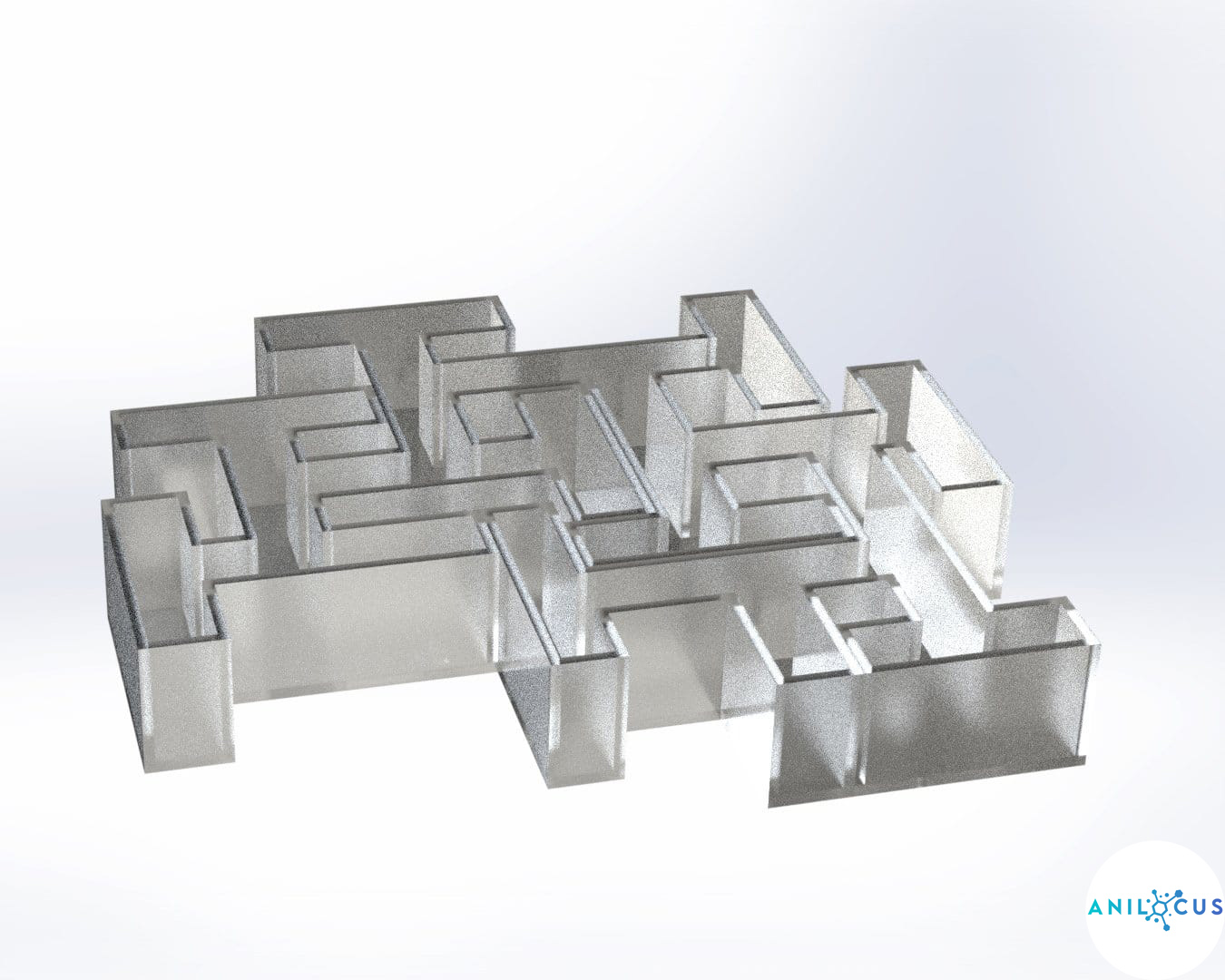
The Cincinnati Water Maze (CWM) is a sophisticated 9-unit multiple T-maze system designed to assess egocentric navigation and route-based learning in laboratory rodents. Unlike spatial memory tests that rely on external landmarks, this submerged T-maze evaluates the brain’s ability to learn and remember sequential movement patterns through internal body-based cues. The Cincinnati water maze task addresses critical limitations in behavioral neuroscience by providing a validated method to specifically test striatal-dependent procedural memory formation, making it essential for research into movement disorders, neurodegenerative diseases, and dopaminergic system function.
This water T-maze system forces animals to navigate complex pathways by finding openings along corridor walls rather than at passage ends, creating a challenging route-based learning paradigm. When combined with infrared testing capabilities, the Cincinnati multiple T-maze eliminates visual spatial cues to isolate pure egocentric navigation, revealing striatal function abnormalities that traditional spatial memory tests might miss.
Key Features and Benefits
- 9-Unit Multiple T-Maze Design – Provides complex sequential learning challenges with 80% greater difficulty than traditional 6-unit mazes for enhanced sensitivity to cognitive deficits.
- Asymmetric Path Structure – Features distinct Path A (50/50 choice probability) and Path B (complex mid-corridor turns) routes for graduated difficulty assessment and comprehensive procedural learning evaluation.
- Infrared Dark Testing Capability – Eliminates visual spatial cues to isolate pure egocentric navigation and striatal-dependent learning without confounding allocentric strategies.
- Seamless Acrylic Construction – Prevents climbing escape attempts and eliminates seam-based navigation cues that could confound route-based learning assessment.
- Integrated Drainage System – Facilitates rapid water changes and temperature maintenance for consistent testing conditions and animal welfare.
- Submerged Platform Escape – Provides strong motivation for task completion without requiring food restriction or extended training periods.
Applications in Behavioral Neuroscience
Egocentric Navigation Studies
Assess route-based learning and procedural memory formation through sequential T-maze navigation that depends on dorsal striatum function rather than hippocampal spatial processing.
Procedural Memory Research
Investigate the development of automated behavioral sequences and habit formation in models of Parkinson’s disease, Huntington’s disease, and other movement disorders affecting striatal circuits.
Neurodevelopmental Toxicology
Evaluate developmental exposure effects on procedural learning systems using validated protocols sensitive to prenatal and early postnatal neurological disruptions.
Dopaminergic System Function
Study the role of dopamine in route-based learning through lesion studies, pharmacological manipulations, and genetic models affecting striatal dopamine signaling.
Comparative Navigation Systems
Distinguish egocentric from allocentric navigation capabilities when used alongside Morris water maze testing to comprehensively assess spatial versus procedural memory systems.
Scientific Validation
The Cincinnati Water Maze has been extensively validated in peer-reviewed research since its development by Dr. Charles Vorhees and Dr. Michael Williams at Cincinnati Children’s Hospital. Published studies demonstrate its sensitivity to developmental neurotoxicant exposures, genetic modifications affecting striatal function, and pharmacological interventions targeting dopaminergic systems. The maze has been successfully used in research investigating prenatal phenytoin exposure, manganese neurotoxicity, and 6-OHDA lesion models, with findings published in journals including Neurotoxicology and Teratology, Neurobiology of Learning and Memory, and Behavioral Brain Research.
Specifications
| Specification | Details |
|---|---|
| Overall Dimensions | 200 cm x 200 cm x 51 cm (79″ x 79″ x 20″) |
| Channel Width | 15.2 cm (6″) throughout maze |
| Wall Height | 51 cm (20″) to prevent escape |
| Water Depth | 20-22 cm (8-9″) with submerged platform |
| Construction Material | Clear acrylic/Plexiglas with seamless welded joints |
| Platform Size | Submerged 1-2 cm below water surface |
| Drainage System | Integrated drain with overflow protection |
| Weight | 180 kg (397 lbs) when empty |
| Species Compatibility | Rats (primary), limited mouse applications |
| Testing Conditions | Standard lighting or infrared dark conditions |
Equipment Integration
The Cincinnati Water Maze integrates seamlessly with our behavioral analysis software and video tracking systems. The clear acrylic construction provides optimal contrast for automated behavioral analysis, while infrared-transparent materials enable dark testing with IR-sensitive cameras. The system is compatible with overhead camera mounting systems and supports real-time data acquisition for latency and error measurements. Temperature monitoring and control systems can be integrated for precise environmental management during extended testing protocols.
NeuroTrack Pro Software Integration Features:
- Real-time escape latency measurement and error counting
- Automated path analysis and navigation pattern recognition
- Heat map generation for route preference visualization
- Statistical analysis templates for procedural learning assessment
- Data export compatibility with standard research formats
Documentation
Getting Started
- CWM Assembly and Setup Guide – How to put together the maze, fill it with water, and set up drainage.
- CWM Pre-Training Swimming Assessment – Test if your rats can swim before putting them in the maze.
- Cincinnati Water Maze Testing Protocol – Basic daily testing procedures with timing and trial sequences.
- CWM Path A vs Path B Protocols – How to test the easy route versus the hard route.
- CWM Infrared Dark Testing – Running the maze in complete darkness using infrared cameras.
How to Score the Cincinnati Water Maze
- CWM Error Scoring Guidelines – How to count wrong turns and dead-end entries.
- CWM Data Calculation Methods – Formulas for calculating escape time and error rates.
- Cincinnati Water Maze Analysis Templates – Spreadsheets with built-in calculations for your data.
Advanced Applications
- CWM Navigation Comparison Studies – Comparing CWM results with Morris Water Maze data.
- CWM Procedural Memory Research – Using the CWM with 6-OHDA lesions and Parkinson’s models.
- CWM Video Tracking Integration – Connecting your cameras to automatically track rat movements.
Troubleshooting & Optimization
- CWM Troubleshooting Manual – Learn how to fix common Cincinnati Water Maze problems.
Ordering Information
Standard Configuration
- Complete 9-unit multiple T-maze with integrated drainage system
- Submerged escape platform with height adjustment
- Installation and setup support included
Optional Upgrades
- Infrared camera system for dark testing protocols
- Automated water temperature control and monitoring
- Video tracking software integration package
- Custom platform mechanisms and positioning systems
Shipping Information
- Shipping Dimensions: 220 cm x 220 cm x 70 cm (87″ x 87″ x 28″)
- Shipping Weight: 180 kg (397 lbs)
- Professional installation recommended due to size and complexity (contact us about Professional Installation)
Frequently Asked Questions (FAQ)
What species is the Cincinnati Water Maze compatible with?
The system is primarily optimized for laboratory rats weighing 200-400g. While some researchers have used it with mice, the large size and complex navigation requirements make it challenging for smaller rodents, who may exhibit floating behavior rather than active swimming.
How long does it take animals to learn the maze?
Learning time depends on lighting conditions and path difficulty. Under standard lighting, rats typically master Path A in 5-6 days and Path B in 7-10 days. Under infrared dark conditions, learning requires 18-24 days due to the elimination of visual spatial cues.
What makes this different from a Morris Water Maze?
The Cincinnati Water Maze tests egocentric (route-based) navigation using internal body cues, while the Morris Water Maze tests allocentric (spatial) navigation using external landmarks. The Cincinnati maze specifically evaluates striatal-dependent procedural learning rather than hippocampal-dependent spatial memory.
Is pre-training required before maze testing?
Yes, animals must complete 4 trials in a straight water channel to demonstrate swimming ability and learn that submerged platforms provide escape routes. This prevents high failure rates and ensures valid navigation assessment.
Can the maze be used for drug testing studies?
Absolutely. The Cincinnati Water Maze is highly sensitive to pharmacological interventions affecting dopaminergic systems, striatal function, and procedural memory formation, making it valuable for drug development and neurotoxicology research.
What water temperature should be maintained?
Water temperature should be maintained at 20-22°C (68-72°F) to promote motivation while preventing thermal stress. Warm water slows learning performance, while cold water can cause hypothermia and reduced swimming activity.
Reviews
There are no reviews yet.