
Description
Overview
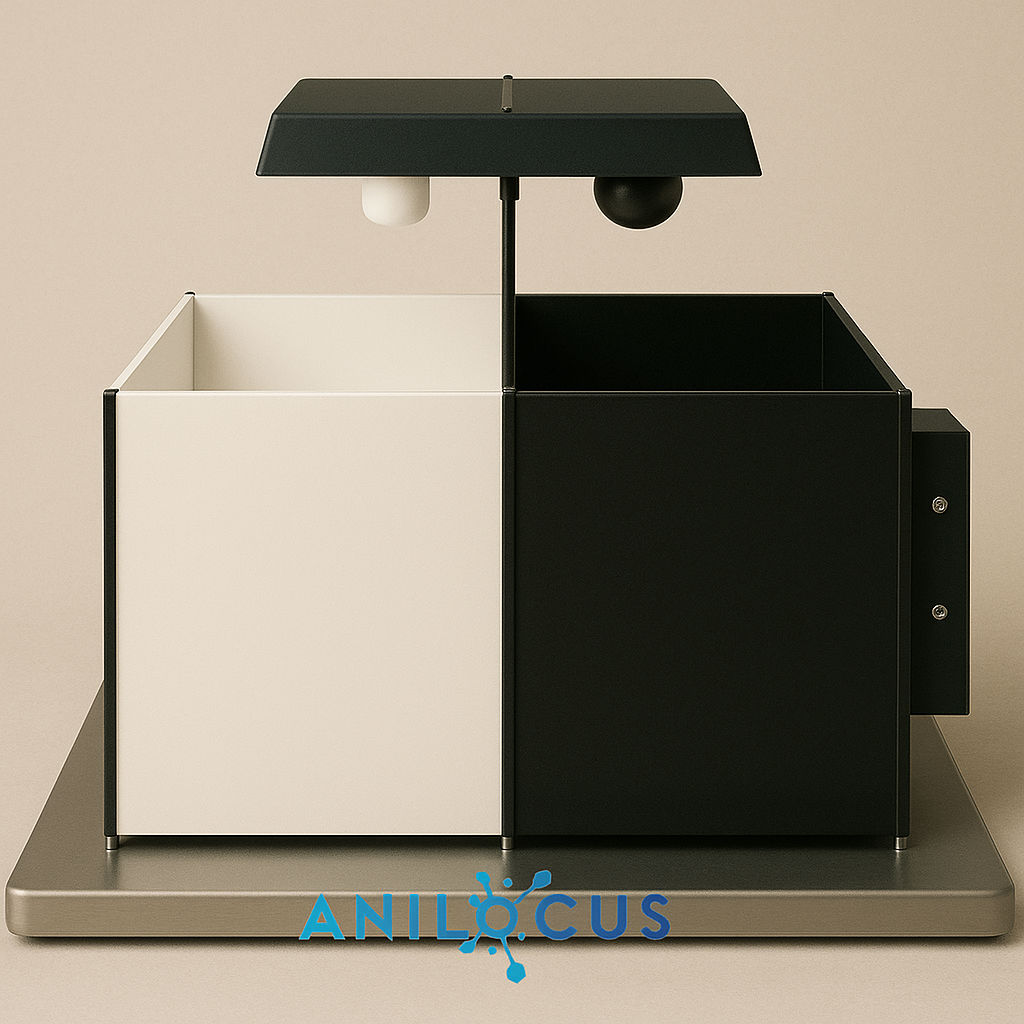
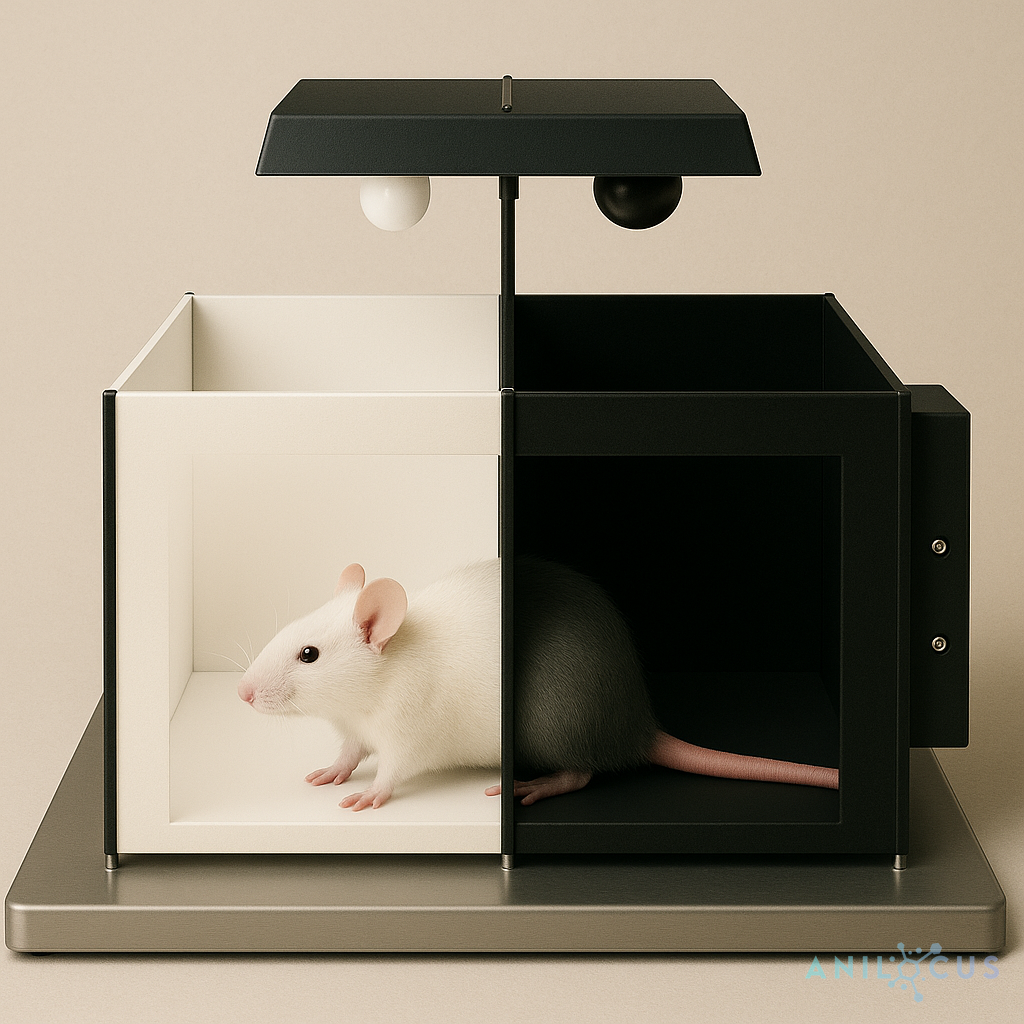
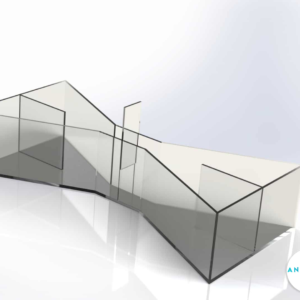
The Light-Dark Box (or Black and White Box) is a fundamental behavioral testing apparatus designed for assessing anxiety-like and depression-like behaviors in rodents through approach-avoidance paradigms. This two-compartment system exploits the natural conflict between rodents’ innate aversion to brightly illuminated areas and their spontaneous exploratory behavior in novel environments. The Black and White Box addresses critical needs in psychopharmacological research by providing a reliable, standardized method for evaluating anxiolytic and anxiogenic compounds, making it essential for drug discovery, behavioral neuroscience research, and the investigation of mood disorders in animal models.
The black and white (or dark light) box allows easy and quick evaluation of the animal anxious behavior and its modification by pharmacological agents by assessing the animal displacements in two compartments with different size, color and illumination. Shorter latencies to enter and/or greater amounts of time spent in the light side of the box are interpreted as indicating less anxiety-like behavior or an anxiolytic-like effect. When rodents are injected with anxiolytic drugs, percentage of time spent in the light compartment will increase.
Key Features and Benefits
- Asymmetric Compartment Design – Features a small black compartment and large white compartment with contrasting illumination for optimal behavioral differentiation
- Precision Construction – Built from high-grade material with removable floors featuring 90 × 90 mm sector markings for detailed behavioral analysis
- Independent Illumination Systems – White compartment illuminated with 100W bulb, black compartment with 40W red bulb, both positioned 370mm from floor
- Automated Detection Technology – Optional weight transducer system for precise animal position detection without video tracking complications
- Multi-Chamber Capability – Support for up to 8 automated experimental chambers with centralized control and data collection
- Rapid Assessment Protocol – Enables quick evaluation of anxiety-like behaviors in 5-15 minute testing sessions
Applications in Behavioral Neuroscience
Anxiety Disorder Research
The light/dark test is based on the innate aversion of rodents to brightly illuminated areas and on the spontaneous exploratory behaviour of rodents in response to mild stressors, that is, novel environment and light. Researchers can assess baseline anxiety levels and evaluate therapeutic interventions for anxiety disorders through precise measurement of compartment preferences.
Antidepressant and Anxiolytic Drug Screening
The apparatus enables comprehensive pharmacological evaluation by assessing animal displacements between compartments with different size, color and illumination. Drug-induced increases in exploratory behavior and time spent in the bright chamber indicate anxiolytic activity, while decreases suggest anxiogenic effects. The only drug class that has shown consistent results are the benzodiazepines.
Stress-Related Behavioral Assessment
Chronic social defeat stress produces behavioral and physiological consequences relevant to psychiatric illnesses, including anxiety and depression, with animals showing increased latency to enter the light side of a light-dark box, making it valuable for stress research applications.
Genetic and Transgenic Model Validation
The apparatus enables assessment of anxiety-like phenotypes in genetically modified animals, knockout models, and transgenic lines modeling psychiatric disorders including autism spectrum disorders and depression.
Environmental and Developmental Studies
The dark/light compartment test has been established to study anxiolytic drug effects and is widely used to assess the level of anxiety in rodents, with experiments performed on both sexes to investigate whether males and females differ at different ages.
Scientific Validation
The light/dark transition test was originally described in 1980 by Crawley and Goodwin. Since then, it has become one of the most widely used tests to measure anxiety-like behavior in mice. It has been shown that the light/dark box test is sensitive to both anxiolytic and anxiogenic drug treatment. Published studies demonstrate robust pharmacological validation with benzodiazepines, consistent behavioral responses across laboratories, and reliable detection of anxiety-related phenotypes in disease models. The apparatus has been extensively validated across multiple species and experimental conditions, establishing it as a gold standard for anxiety assessment in preclinical research.
Specifications
| Specification | Details |
|---|---|
| Overall Construction | High-grade material with asymmetric compartment design |
| Compartment Configuration | Small black compartment + large white compartment with connecting gate |
| Floor Specifications | Removable floors with 90 × 90 mm sector markings, color-matched to walls |
| White Compartment Illumination | 100W white bulb positioned 370mm from floor |
| Black Compartment Illumination | 40W red bulb positioned 370mm from floor |
| Connecting Gate | Central gate allowing free movement between compartments |
| Detection System | Optional weight transducer technology for automated position detection |
| Multi-Chamber Support | Up to 8 automated chambers with NeuroTracker Pro software integration |
| Species Compatibility | Mice, rats (species-specific sizing available) |
Equipment Integration
The Black and White Box integrates seamlessly with behavioral analysis software and automated data collection systems. The dark-light box can be supplied with a weight transducer system for automated animal detection. In that case, the automated experimental chambers (up to 8) are associated to the PC-based control software NeuroTracker Pro for data storage and analysis. Even though it may represent a more complex experiment to set due to the strong lighting contrast existing between the compartments, some researchers also use the box with a video tracking system for enhanced behavioral analysis.
Automated Analysis Integration Features:
- Weight transducer technology for accurate position detection in high-contrast environments
- NeuroTracker Pro software for automated data collection and analysis
- Support for up to 8 simultaneous testing chambers
- Real-time monitoring of animal position and compartment transitions
- Optional video tracking compatibility despite lighting contrast challenges
Documentation
Getting Started
- Black and White Box Setup Guide – Complete assembly instructions and illumination system configuration
- Animal Habituation Protocol – Pre-testing procedures and environmental acclimation guidelines
- Basic Testing Protocol – Standard 5-10 minute anxiety assessment procedures
Anxiety Assessment Protocols
- Anxiety Evaluation Protocol – Comprehensive anxiety assessment with compartment displacement analysis
- Pharmacological Screening – Protocols for anxiolytic and anxiogenic compound testing
Data Analysis and Interpretation
- Behavioral Analysis Guide – Measuring latency, transitions, and sector-based movement patterns
- NeuroTracker Pro Analysis – Automated data analysis and reporting with weight transducer data
- Statistical Analysis Methods – Appropriate statistical tests and interpretation guidelines
Advanced Applications
- Multi-Chamber Configuration – Setup and operation of up to 8 simultaneous testing chambers
- Video Tracking Integration – Protocols for overcoming high-contrast lighting challenges
- Genetic Model Applications – Guidelines for testing transgenic and knockout animal models
Troubleshooting & Optimization
- Performance Optimization Guide – Solutions for lighting contrast and detection issues
Ordering Information
Standard Configuration
- Perspex apparatus with small black and large white compartments
- Independent illumination system (100W white bulb, 40W red bulb)
- Connecting gate between compartments
- Removable color-matched floors with 90 × 90 mm sector markings
- Assembly hardware and detailed instructions
Optional Upgrades
- Weight transducer system for automated animal detection
- NeuroTracker Pro software for automated data collection and analysis
- Multi-chamber configurations (up to 8 simultaneous units)
- Enhanced lighting control systems with adjustable intensity
- Video tracking system optimization for high-contrast environments
Shipping Information
- Standard Model Shipping Dimensions: 45 × 35 × 30 cm
- Multi-Chamber System: Custom shipping arrangements
- Professional packaging with protective foam inserts
- Assembly required (approximately 2-3 hours with standard tools)
- Shipping Costs (based on UPS rates): Contact for destination-specific quote
Frequently Asked Questions (FAQ)
What makes this different from a standard light-dark box?
Our Black and White Box features asymmetric compartment sizes (small black, large white), independent illumination systems with specific bulb specifications (100W white, 40W red), and removable floors with 90 × 90 mm sector markings for detailed spatial analysis of animal displacements.
Can video tracking be used with the high lighting contrast?
Even though it may represent a more complex experiment to set due to the strong lighting contrast existing between the compartments, some researchers also use the box with a video tracking system. The weight transducer system is often preferred for reliable automated detection in these challenging lighting conditions.
How many chambers can be operated simultaneously?
The automated experimental chambers (up to 8) can be associated to the PC-based control software NeuroTracker Pro for data storage and analysis, enabling high-throughput anxiety screening and pharmacological studies.
What software is included for data analysis?
The automated version includes NeuroTracker Pro software for comprehensive data storage and analysis when used with the weight transducer system. This provides real-time monitoring and automated data collection across multiple chambers.
How are the sector markings used in analysis?
Each compartment has its own removable Perspex floor with 90 × 90 mm sectors delimited by lines, allowing for detailed spatial analysis of animal movement patterns, exploration behavior, and compartment-specific activity levels.
What are the specific lighting requirements?
The compartments are independently illuminated: the white one with a 100W white bulb and the black one with a 40W red bulb. Both bulbs are positioned 370mm from the floor of the box to ensure consistent and standardized lighting conditions across experiments.
Reviews
There are no reviews yet.